
Accessible Kiosks for Airports and Transit
Get every traveller to the right gate, platform or pier, including travellers who use a wheelchair, a cane or a screen reader.
Passengers want self-service. Regulators want it accessible.
Travellers expect to find their own way. In SITA's 2024 survey of more than 7,000 passengers, 64% named shorter airport queues as the most important improvement.4 Every question a traveller answers at a kiosk is one less at the information desk.
The rules have caught up with the kiosks:
- United States, airports. Airlines must make at least 25% of the automated kiosks they own, lease or control in each location at US airports with 10,000 or more annual enplanements accessible. The deadline passed in December 2022.5
- United States, transit. Where fare machines are provided, at least one of each type at each location must meet the ADA accessibility standards, including speech output.6
- Canada. Transportation service providers' kiosks in terminals must meet the CSA B651.2 accessibility standard, and the Canadian Transportation Agency has issued a $30,000 monetary penalty to an airline over kiosk software that fell short of it.7,8
- European Union. The European Accessibility Act has covered new ticketing and check-in machines since 28 June 2025.9
More than 1 in 4 US adults, and 27% of Canadians aged 15 and over, have a disability.10,11 A kiosk they can't use sends them back to a staffed counter.
Where kiosks work in transportation
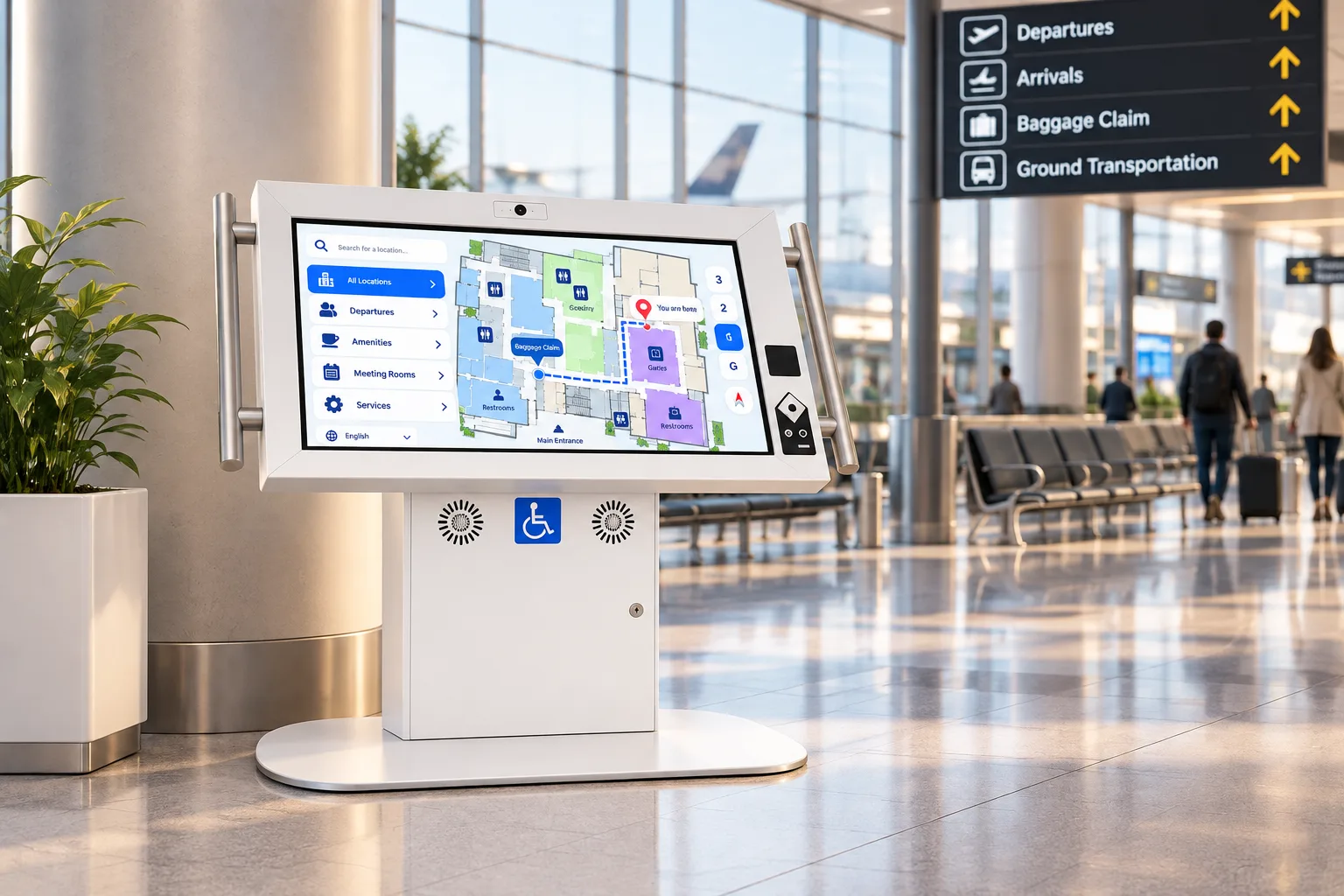
- Terminal wayfinding. Interactive maps that take a traveller from the curb to the gate, the washroom, the lounge or the connecting train.
- Accessible information points. One kiosk for everyone: seated users, users with low vision through audio and the headphone jack, and users who touch with a prosthetic or stylus.
- Boarding pass and ticket lookups. With the optional 1D/2D barcode scanner, the accessible kiosk reads a boarding pass or ticket so your application can show the traveller where to go next.
- Fare and ticket self-service. Hardware for your ticketing application, in accessible and outdoor formats.
- Ground transportation. Transit, rail, taxi and rideshare directions at arrivals, with departures fed from your systems.
- Transit stations and bus terminals. Route maps, service alerts and trip planning, indoors or on an exposed platform.
- Ferry terminals and cruise ports. Boarding information, schedules and directions at the dock or in the terminal.
- Remote assistance. With the optional camera, microphone and speakers on the accessible kiosk, an agent can help travellers by video at unstaffed concourses and after hours, using your video calling software or Video Presence, our real-time video platform.
- Concessions and discovery. Help passengers find food, shops and services between security and the gate.
Multilingual service is an application choice: your software can offer every language your travellers need, on screen and through the headphone jack.
Recommended hardware
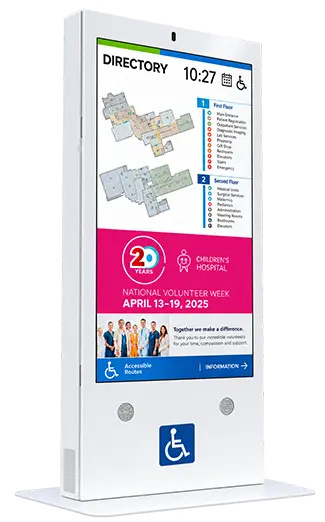
Duraline Angled Accessibility Kiosk
32, 43, 50 in
Best for
Accessible wayfinding and information points inside terminals
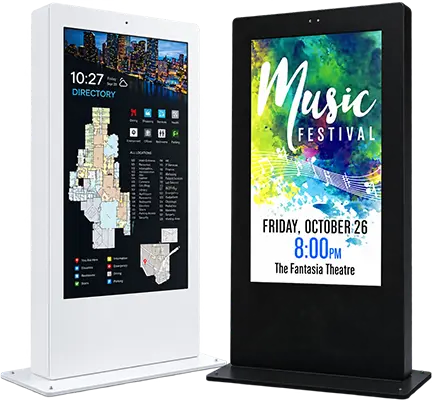
Product SpecsDuraline Kiosk
43 to 55 in
Best for
High-traffic concourses and gate areas
Product SpecsDuraline Outdoor Kiosks
55 to 75 in, single or double sided
Best for
Bus bays, platforms, ferry docks and curbside, in any season
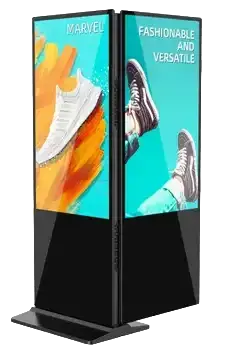
Product SpecsLinea Double Sided
Best for
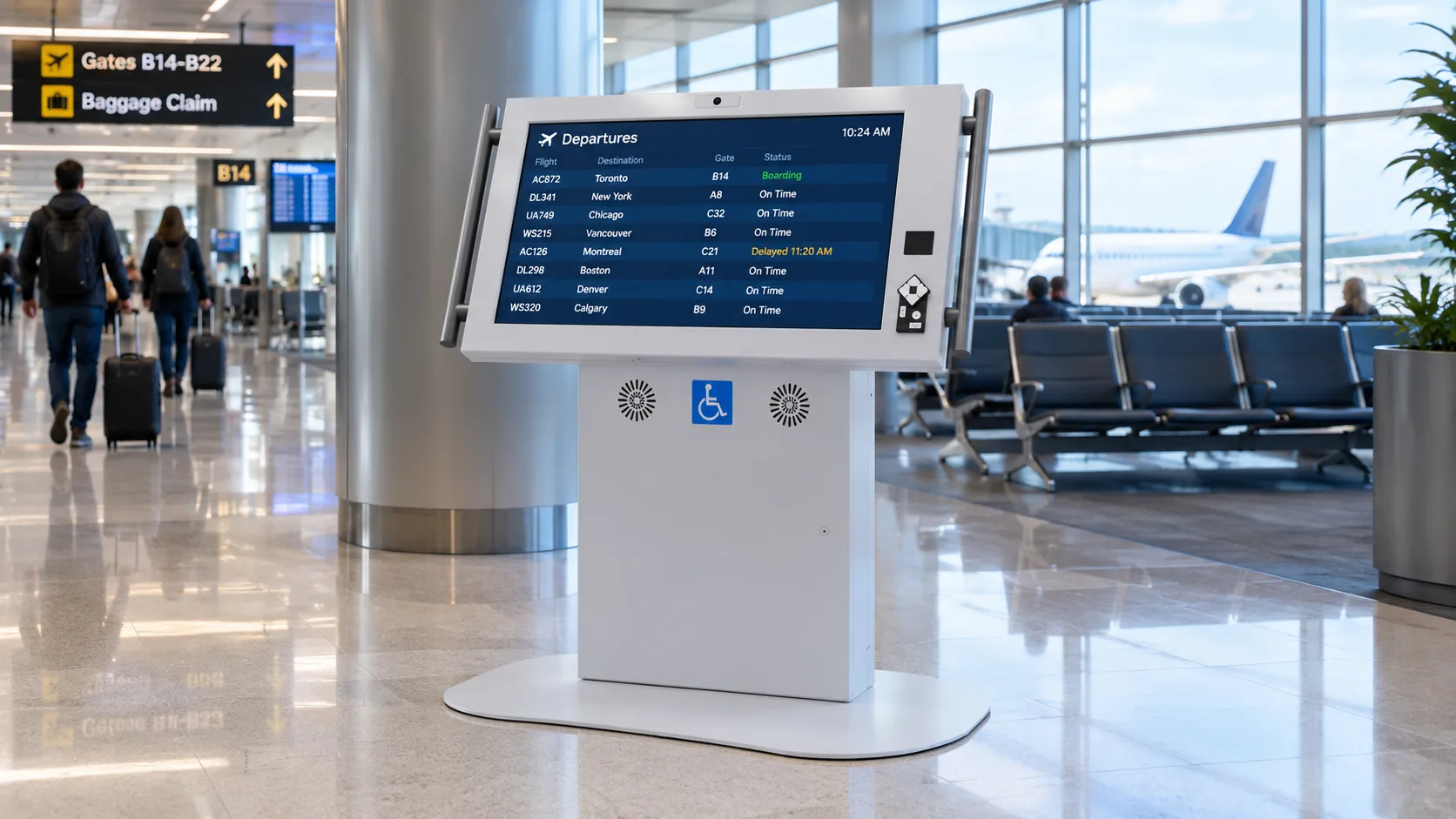
Departure and arrival information seen from both directions along a concourse
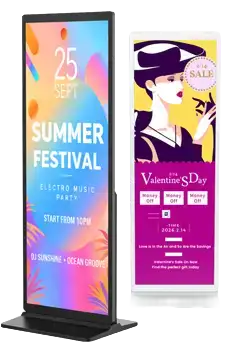
Product SpecsLinea Full Screen
Best for
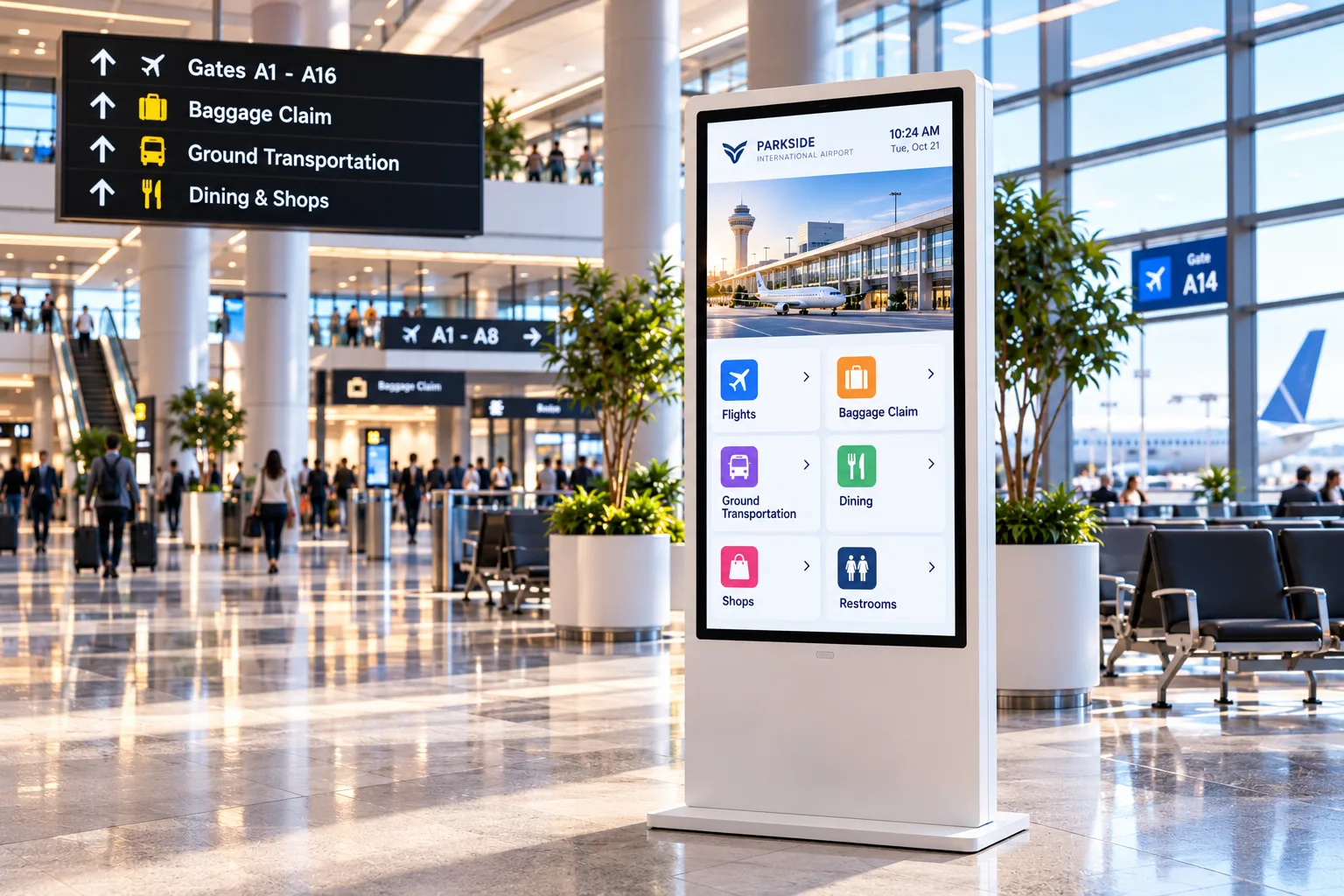
Tall, high-visibility information displays at entrances and junctions
Product Specs
Built for a terminal
- Built for 24/7 operation, with commercial-grade displays.
- High-impact steel. Duraline enclosures are built to take public traffic, bumps and bruises; the accessible kiosk is 14-gauge steel.
- Anchored and locked. Duraline kiosks are mounted to the floor, and their components sit behind a locked cabinet door, so they stay put and stay closed in a crowded terminal.
- Readable under terminal lighting. The accessible kiosk's screen sits behind anti-reflective glass.
- Outdoor-rated where it counts. Duraline Outdoor kiosks operate from -40 to 60 °C, use 3,000-nit screens that stay readable in direct sun, have IP66-rated displays and are tested to winds of 135 mph (217 km/h).
- Antimicrobial finish. The accessible kiosk has an antimicrobial powder-coat finish that withstands cleaning with 10% bleach solution. Antimicrobial protection is limited to the finish itself.
- Serviced in place. The accessible kiosk is built from off-the-shelf, USB-connected components, so your technicians can hold spares and swap a part on site instead of shipping the kiosk. Both the US airport kiosk rule and Canada's transportation accessibility regulations require kiosks to be kept in working order.5,7
Designed to CSA/ASC B651.2:25
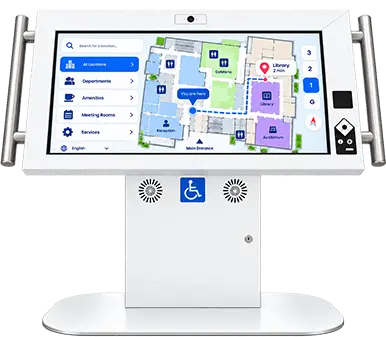
The Duraline Angled Accessibility Kiosk is designed to CSA/ASC B651.2:25, the National Standard of Canada for accessible self-service interactive devices.
| What a traveller needs | How the kiosk provides it |
|---|---|
| Reach from a wheelchair | Screen tilted at 30 degrees, keypad and optional scanner within the 400 to 1,200 mm reach range, and 685 mm of knee clearance to pull in close |
| Touch without fingertip contact | Infrared touch that responds to a finger, a prosthetic or a stylus |
| Use without reading the screen | Tactile audio keypad with an illuminated 3.5 mm headphone jack and a volume key |
| Support while standing | Contrasting grab bars rated to 1.3 kN |
| Hearing assistance | Optional assistive listening package with an induction loop and Auracast broadcast audio |
| A clear approach | A 6 mm base plate a wheelchair rolls onto |
The kiosk is half of accessibility. The application on the screen must also be accessible: audio output to the headphone jack, keypad navigation and zoom. Plan both together from the start. Read about the accessibility standards.
Runs your software
humanKIOSK supplies the hardware; your airport, transit authority or integrator chooses the software. Keep the wayfinding or ticketing platform you already run. On the accessible kiosk, the keypad and the optional barcode scanner, camera and speakers connect by USB, with an optional mini PC or your own.
Who we work with
Airport authorities, transit agencies, terminal operators, wayfinding consultants, architects and the integrators who deliver their projects. Installation drawings for the accessible kiosk are available on request.
Frequently asked questions
Does the kiosk meet the US airport kiosk rule, 14 CFR 382.57?
The rule sets hardware requirements, such as tactile controls, speech output and clear floor space, and requirements for the software running on the kiosk. Compliance depends on both and on how the kiosk is installed, so review the hardware specification against the rule with your accessibility team.
Which edition of CSA B651.2 do Canadian transportation regulations reference?
The Accessible Transportation for Persons with Disabilities Regulations reference the 2007 edition (reaffirmed 2017).7 The Duraline Angled Accessibility Kiosk is designed to the current 2025 edition. Your accessibility team should confirm which edition your project must meet.
Should a terminal wayfinding kiosk be portrait or landscape?
Landscape. A landscape screen keeps interactive content within the reach heights set by CSA/ASC B651.2:25 and leaves room for a wheelchair to pull in underneath. A long terminal map also fits a wide screen better.
Do you have kiosks for outdoor platforms and bus bays?
Yes. Duraline Outdoor kiosks are all-weather, single or double sided, with high-brightness sealed displays and an optional infrared touch overlay that works with gloved hands.
Related industries
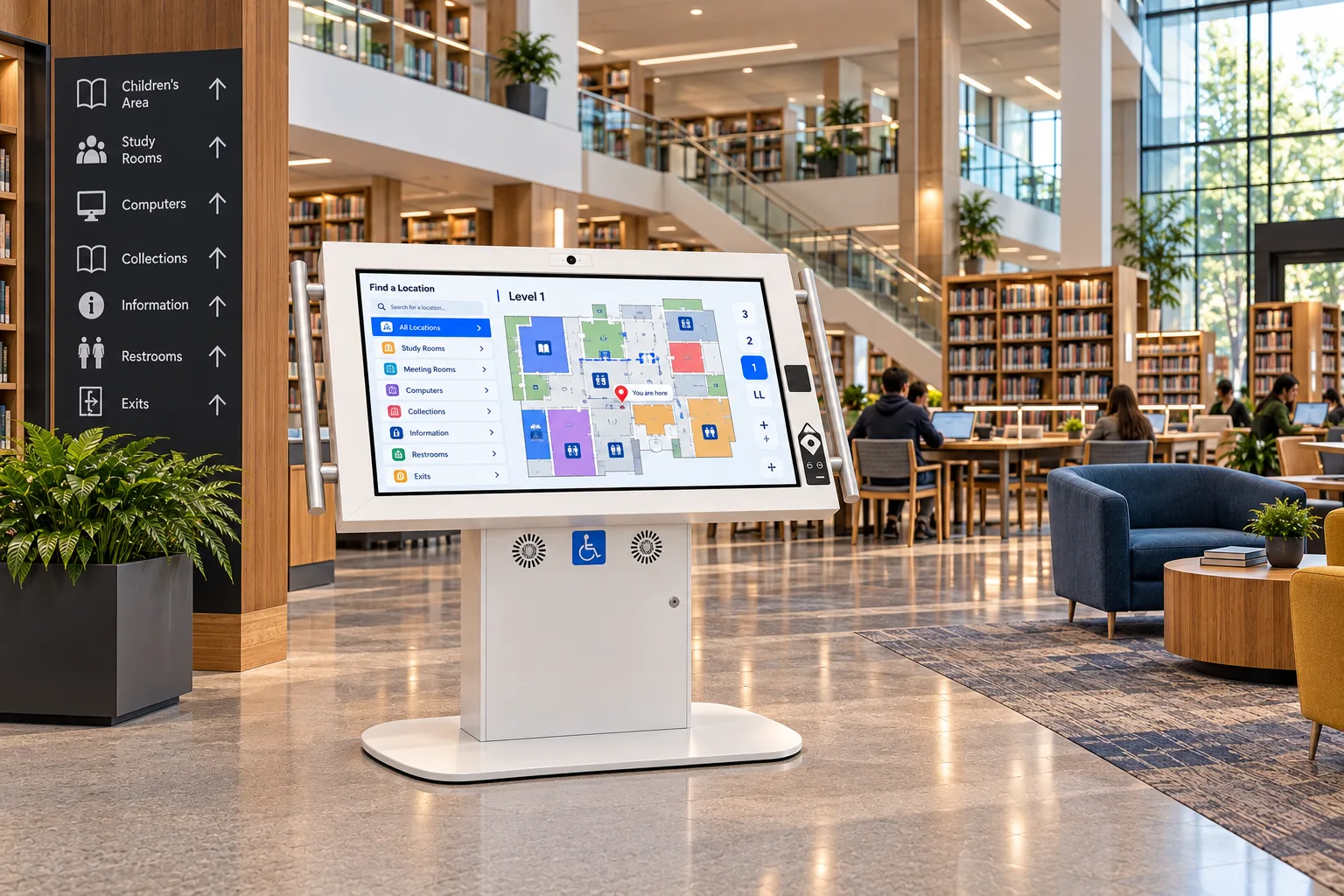 Government & LibrariesAccessible self-service for city halls, service centres, courts and public libraries.
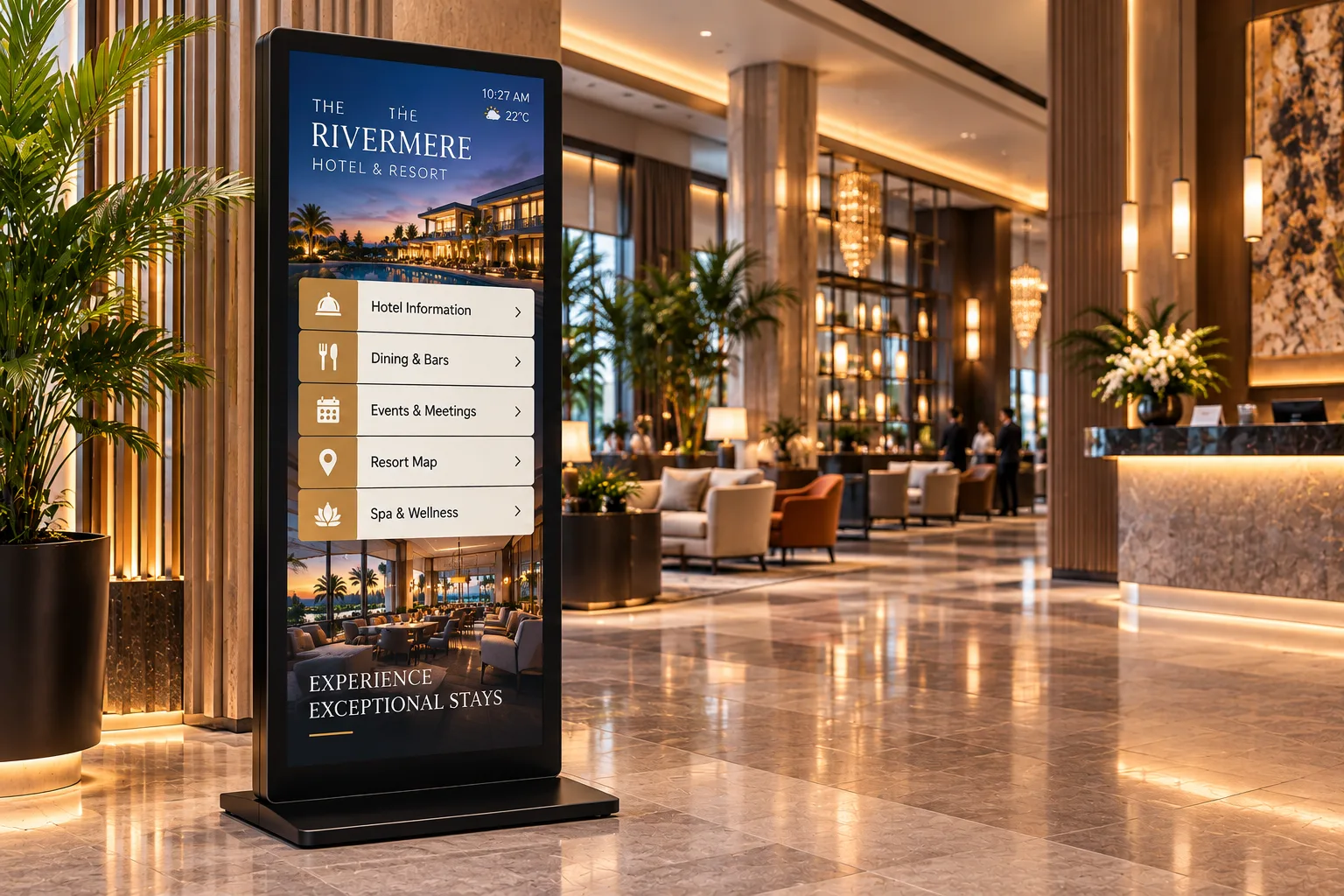 Hospitality & VenuesGuest self-service and wayfinding for hotels, casinos, stadiums, convention centres and trade shows.
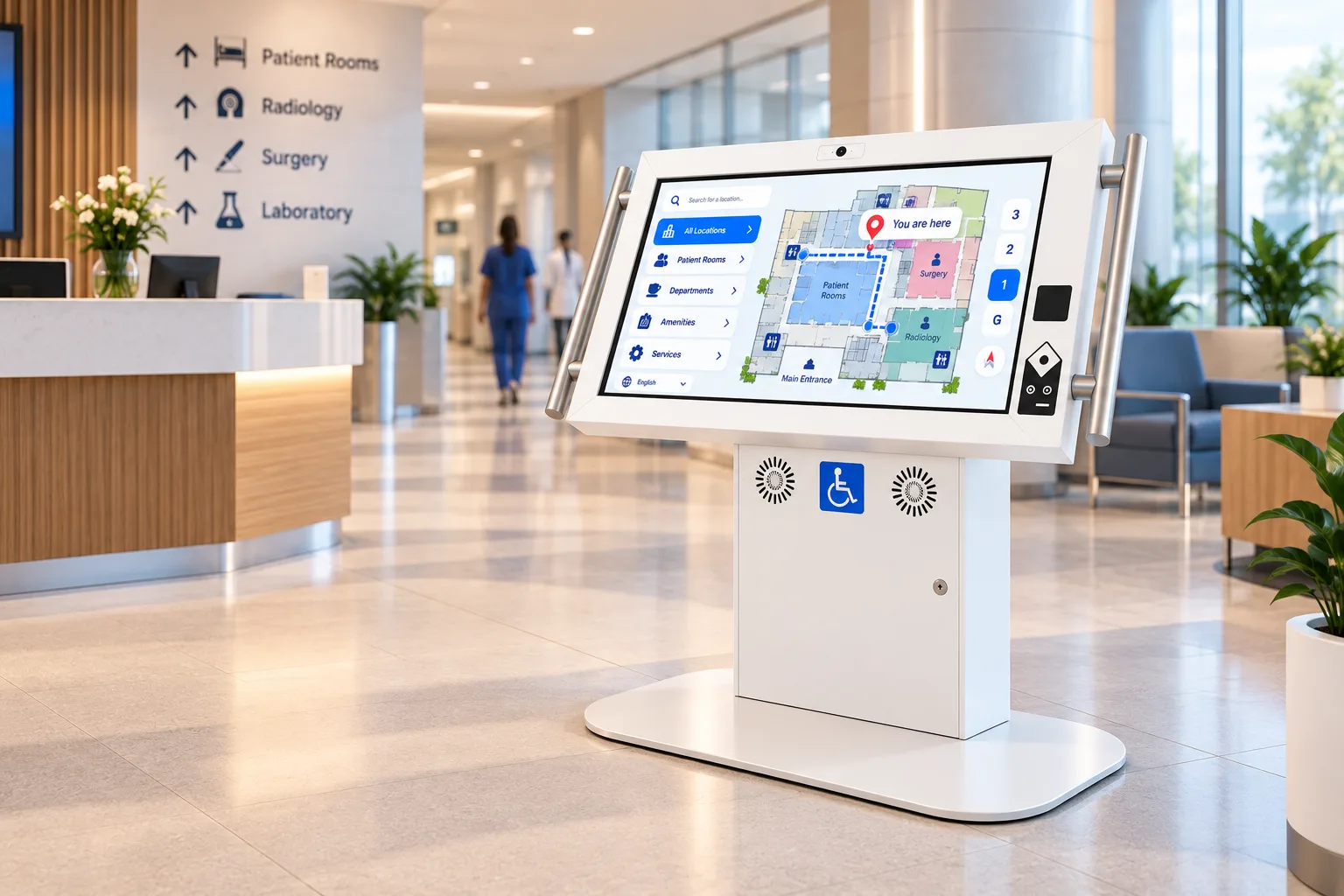 HealthcareCheck-in, wayfinding and patient information on accessible kiosks with an antimicrobial finish.
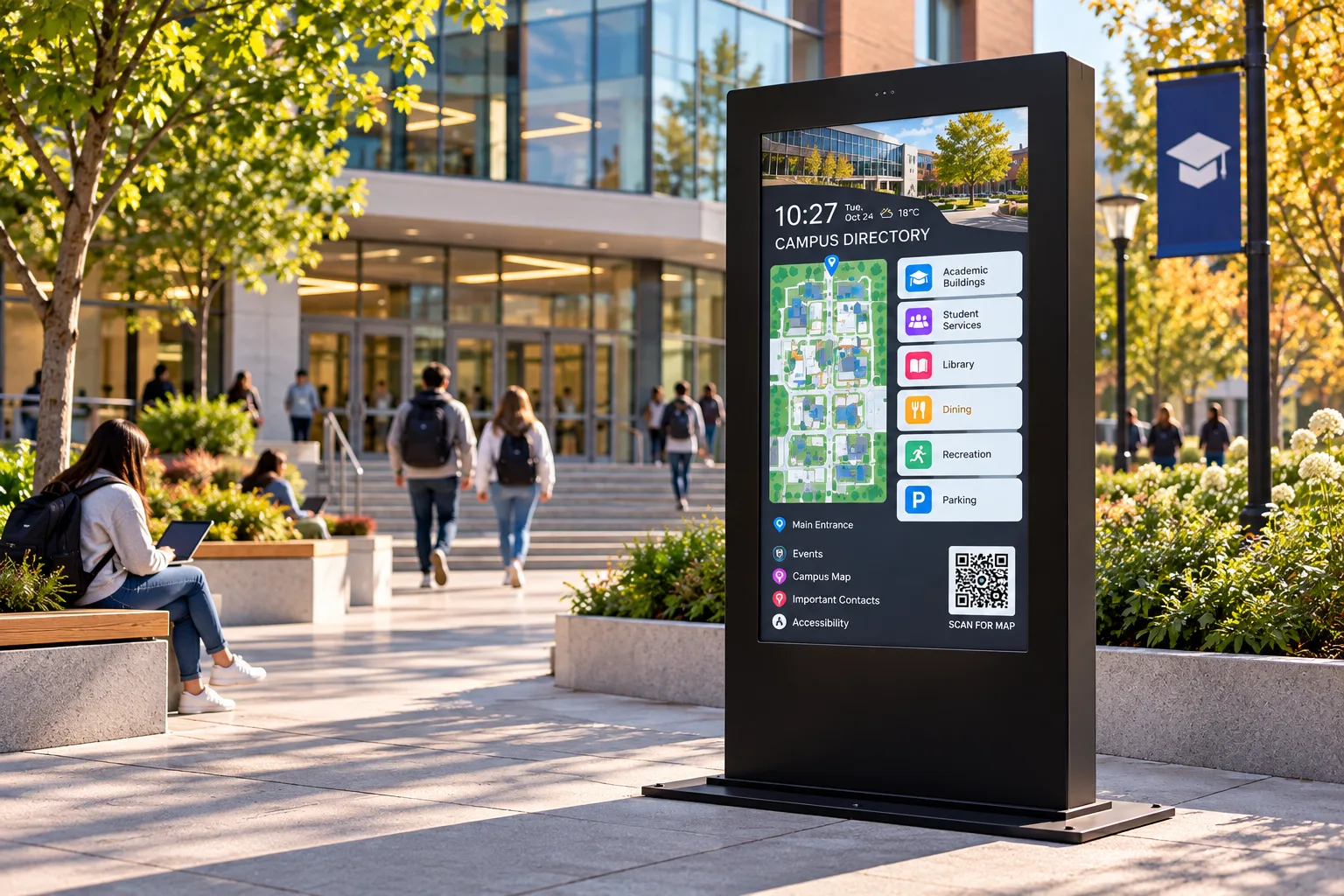 EducationWayfinding, student services and campus-wide notices on kiosks built for a student body.
 Museums & AttractionsInteractive exhibits, visitor wayfinding and accessible interpretation for museums, science centres, zoos and parks.
 Retail & RestaurantsSelf-ordering, product lookup and promotion for stores, restaurants, malls and bank branches.
 Corporate & Real EstateLobby directories, visitor check-in and workforce communication for offices, buildings and plants.
Sources
- SITA, Air Transport IT Insights 2025, Airports. https://www.sita.aero/resources/surveys-reports/air-transport-it-insights-2025/airports/
- ACI World, global airport traffic forecasts, 28 Jan 2026. https://aci.aero/2026/01/28/aci-world-releases-global-airport-traffic-forecasts-as-long-term-demand-growth-continues-to-reshape-aviation/
- American Public Transportation Association, press release, 4 Sep 2025. https://www.apta.com/press-release/new-apta-data-shows-public-transportation-drives-economic-growth-creates-jobs-and-powers-u-s-mobility/
- SITA, Passenger IT Insights 2024 press release, 18 Sep 2024. https://www.sita.aero/about-us/pressroom/news-releases/technology-is-the-key-to-unlocking-the-passenger-experience-of-the-future/
- 14 CFR 382.57, Accessibility of automated airport kiosks. https://www.law.cornell.edu/cfr/text/14/382.57
- US Access Board, ADA Accessibility Standards, sections 220.1 and 707. https://www.access-board.gov/ada/
- Accessible Transportation for Persons with Disabilities Regulations, SOR/2019-244, s. 11. https://laws-lois.justice.gc.ca/eng/regulations/SOR-2019-244/FullText.html
- Canadian Transportation Agency, enforcement action, 21 Feb 2023.
- Directive (EU) 2019/882 (European Accessibility Act), Art. 2(1)(b). https://eur-lex.europa.eu/legal-content/EN/TXT/HTML/?uri=CELEX:32019L0882
- CDC, "Disability Impacts All of Us". https://www.cdc.gov/disability-and-health/articles-documents/disability-impacts-all-of-us-infographic.html
- Statistics Canada, Canadian Survey on Disability 2022, The Daily, 1 Dec 2023. https://www150.statcan.gc.ca/n1/daily-quotidien/231201/dq231201b-eng.htm
Plan your terminal kiosks
Tell us where travellers need help, and we'll recommend the right kiosk for each spot. Integrators and resellers: become a partner.